
Most grapes stay close to where they are known. Malbec moved. For centuries it belonged to a river valley in south-west France. It lost its place in Bordeaux, survived a plague of insects and a killing frost, and found a second home in a desert at the foot of the Andes.
Parts of this story are well recorded. Other parts are the version that has been handed down, and the dates do not always agree. We will say so when we get to them.
The grape of Cahors
Start in the Lot valley, around the old town of Cahors. The river bends back on itself again and again there, and vines have grown on its banks and the slopes above them for a very long time.
In Cahors the grape is not usually called Malbec. Its local name is Côt, and you will also hear Auxerrois. Malbec is the name that travelled.
Cahors is the grape's stronghold, but probably not its birthplace. The French ampelographer Pierre Galet thought Côt most likely came from northern Burgundy. How and when it reached the south-west is not clear. What is clear is that it stayed, and that Cahors became the place most closely tied to it.
It still is. Red wine sold as Cahors has to be made with at least 70 percent Malbec. Color is still the first thing you notice in a glass of Malbec, from Cahors or anywhere else.
A Bordeaux grape that fell out of favor
Malbec also grew in Bordeaux, to the west, where it was one of the grapes allowed in the region's red blends. It worked alongside Cabernet Sauvignon, Merlot and Cabernet Franc, and it brought color and softness. If you want to know how it differs from Cabernet in the glass, we wrote a short guide to Malbec vs. Cabernet Sauvignon.
Bordeaux was never an easy place for it. The region sits close to the Atlantic, and spring can be cool and wet. Malbec is prone to what growers call coulure. If the weather turns bad while the vine is flowering, many of the flowers never become grapes, and much of the crop is lost before summer starts. It is also vulnerable to rot.
Over the 20th century, Bordeaux growers planted less of it. Merlot and Cabernet Franc took its place. Then, in 1956, a hard frost wiped out much of the Malbec that was left, in Bordeaux and in Cahors. Today it is a minor grape in Bordeaux. Cahors kept it.
The vine louse
Before the frost came the insect.
In the second half of the 1800s, growers across France watched their vines weaken and die. First a few, then whole vineyards. The cause was phylloxera, a tiny insect, related to aphids, that feeds on vine roots. It had come from North America, where native vines had lived alongside it and could tolerate it. European vines could not.
It spread through nearly every wine region in France. In Cahors, the worst of it came between 1883 and 1885.
The answer was grafting. Growers took their own varieties and joined them onto the roots of American vines. The part above ground stayed Malbec, or Merlot, or whatever had grown there before. The roots underneath were American. Most of the world's vineyards are still planted this way.
French cuttings for Mendoza
Meanwhile, on the other side of the world, Argentina was looking to Europe for ideas about how to farm.
The politician Domingo Faustino Sarmiento was one of the loudest voices for that. The story usually told is that he had a French agronomist, Michel Aimé Pouget, bring cuttings of French vines to Argentina, Malbec among them. Some accounts say Malbec reached Mendoza from Chile, across the Andes. The dates given vary. What the sources agree on is that it arrived in the middle of the 1800s, and that Mendoza is where it settled.
The timing may have mattered. Phylloxera did reach South America, but in Argentina it has never done anything like the damage it did in Europe, and many vineyards there are still planted on their own roots. Some writers go further and suggest that the Malbec planted in Argentina may preserve a form of the vine that later disappeared in France. That is possible. It is also hard to prove, and vines in Mendoza have been selected, propagated and replanted many times since.
Each year on April 17, the wine world marks Malbec World Day, a date set by Wines of Argentina, the country's wine trade body. It is a good day to open a bottle, whichever version of the story you prefer.
Why Malbec thrived in Mendoza
Mendoza is a desert. Very little rain falls, and the sun is strong for most of the year. What makes vineyards possible is the snow on the Andes. It melts through spring and summer, runs down into rivers, and from the rivers into irrigation channels that spread across the plain.
The seasons run the other way, too. In Mendoza the vines bud around October and flower in November. Harvest comes in late summer and early autumn, roughly March and April. A cutting carried from France had to settle into a new calendar as well as a new climate. Our Southern Hemisphere wine calendar walks through the year month by month.
For Malbec, this was close to the opposite of Bordeaux. The dry air kept rot down. Flowering was less often ruined by cold rain. The grapes had a long, sunny season to ripen, and the wines came out deep in color and round.
A grape that had struggled in a damp climate found one that suited it. Over the decades Mendoza became the center of Argentine wine, and Malbec became the grape it was known for. Our short guide to Mendoza wine country covers the climate and the sub-regions, including Luján de Cuyo, in more detail.
Our part of the story
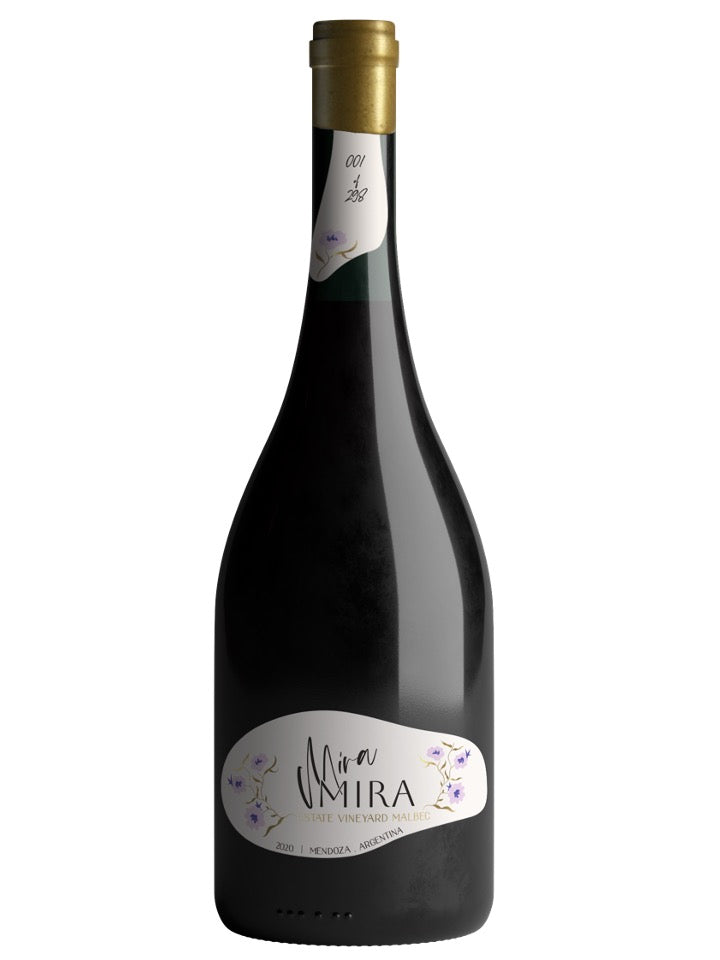
Our vineyard is in Perdriel, a district of Luján de Cuyo, in Mendoza. The vines there were planted in 1927. For almost a century the vineyard stayed family-owned, handed down from generation to generation. We bought it in 2021, and we look after it now as it turns 100. The harvest in the first months of 2027 is the harvest of the vines' centennial year.
That puts them in the long middle of this story, well after Malbec settled in Mendoza and long before the rest of the world started asking for it.
We keep this part short on purpose. What we can tell you plainly is the place and the year. If you want to know what a century does to a grapevine, the thick trunk and the smaller crop, our guide to what "old vine" means walks through it.
Malbec today
For most of the 20th century, Argentine wine was made for Argentina and drunk at home. That changed in the 1990s, when Argentine Malbec started being exported, and the world noticed.
Malbec became Argentina's most planted red grape, and most of it grows in Mendoza.
Cahors carries on as well, still making dark red wine from Côt beside the Lot. The same grape in two very different places gives two different wines. Both are made for the table, and our guide to what to pair with Malbec has a long list of ideas.
In Mendoza, April comes near the end of harvest, when the last grapes are coming in. Next April, Malbec World Day falls in our vines' hundredth year.